Barriers
There are plenty of metaphors in life for barriers, real and imagined, and they are powerful forces.
This weekend, I set myself free.

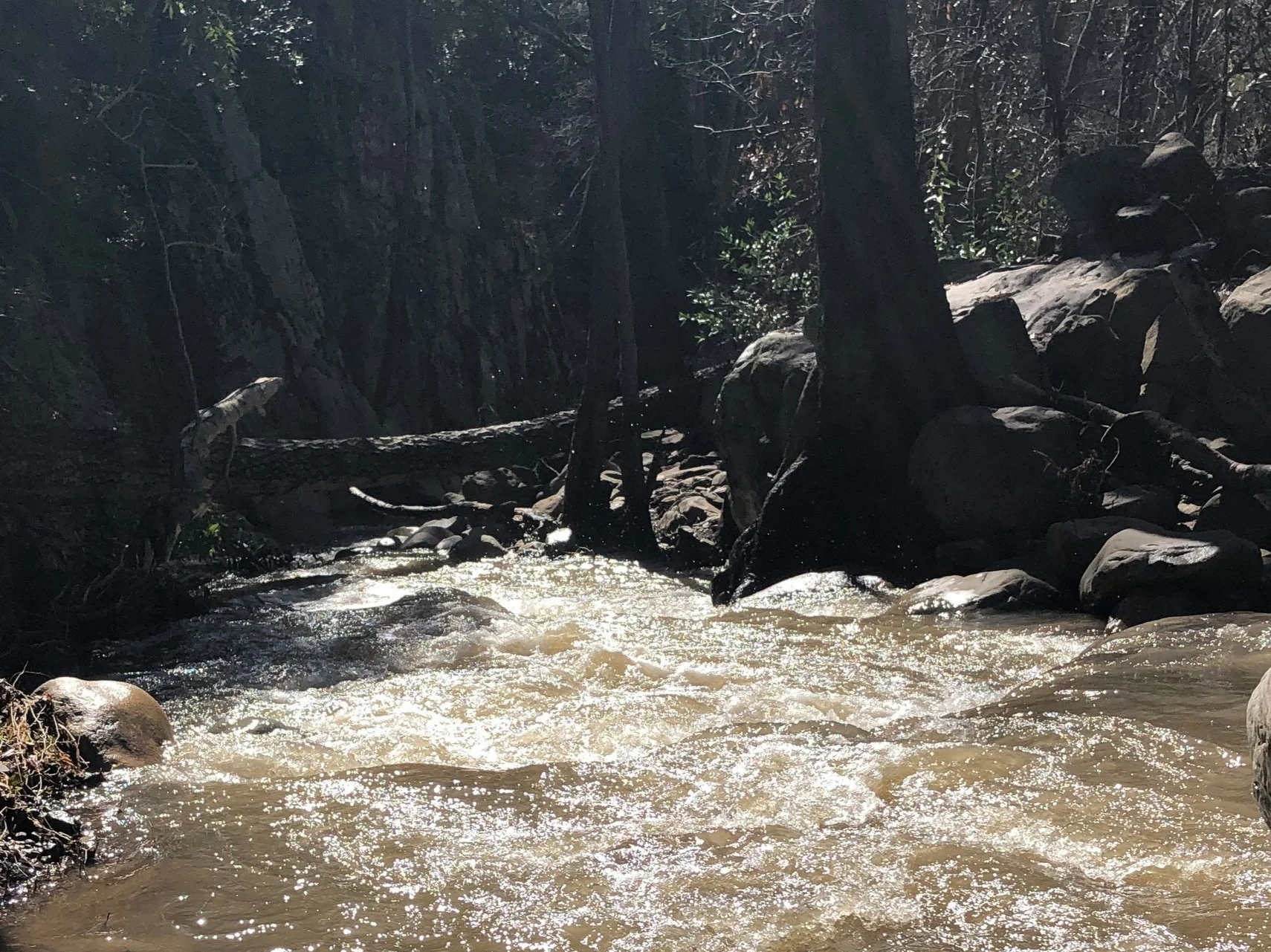
The much-needed atmospheric rivers of late have swollen the nearby creek, and with two crossings in the first two miles of trail, it soon became a barrier to the longer walks I’ve come to enjoy. All that was required was a change of footwear—shoes to barefoot and back again—twice, then I was on my way to the miles of trails into the backcountry. But it took me days—weeks even—to see that the barrier was only ever in my mind.
There are plenty of metaphors in life for barriers, real and imagined, and they are powerful forces. For millennia, natural barriers have led to speciation—isolating populations long enough that they become their own species. Take, for example, the Grand Canyon—squirrels on the north rim are similar but different than those on the south rim, separated from one another once the Colorado River cut so deeply into the earth that the rift could not be crossed.
Barriers are used for protection—we installed a fence around the perimeter of our back yard to keep the dogs and chickens from wandering the neighborhood and getting into trouble. Sunscreen limits ultraviolet radiation, protecting the skin. In the -40-degree winter of the Boreal forest, I wore what would under any other circumstances be a ridiculous amount of clothing and gear to protect my appendages from freezing: a barrier from the dangerous cold.
In the same way that barriers protect, they also divide. Once divided, disparate parts change, no longer able to exchange—in the speciation example, alleles (variant forms of a gene)—between them. Is speciation a good thing? Sure, inasmuch as it allows the divided to adapt to new conditions. This would be the case for species that are fairly abundant on both sides, and—more importantly—allowed to adapt over the course of geologic time, as the squirrels at the Grand Canyon did. But what about species that are already struggling due to persecution, over hunting, and habitat loss, like the Mexican gray wolf and the Sonoran pronghorn? What happens to those species when a barrier is placed in the middle of their range, preventing them from accessing food, water, mates, and other important resources?
The outlook is not good. According to recent research, a continuous barrier along the U.S-Mexico border would disconnect approximately 350 species whose habitats currently straddle the human-made line from the largest portion of their ranges. Adding more border barriers will only further sever critical migration corridors. Our human-conceptualized borders turned to real-life barriers have made arbitrary and artificial boundaries between individuals that were once free to roam for millennia. The existing boundary has only been present for an infinitesimally short period of time compared to the time span that situated the plants and animals there in the first place.
For those unable to appreciate the intrinsic or ecosystem value of wildlife, consider the $26 billion in hunting, fishing, and wildlife watching revenue generated by the biodiversity in and around border towns. We stand to lose much as a nation and a global community when additional border barriers alter the normal patterns of wildlife, flood regimes, and entire landscapes in its path. Researchers are working to count biodiversity at the border to take a baseline before construction—and the damage—ensue.
North America is not alone in its anguish over large-scale perimeter fencing at its borders. Denmark plans to install 40 miles of fencing to keep wild boars—and presumably African swine fever—out. The fence is only slated to be 5 feet high, but it is enough to disrupt the migration patterns of wolves, which have only recently begun to recover after a 200-year absence. Swine flu threatens the pork industry in Denmark, which is one of the largest pork exporters in the world and boasts more pigs than people. Sweeping, drastic measures to solve complex problems cannot be implemented without consequences, both intentional and unintentional.
I am fortunate to live in a place where it is safe to be a woman hiking alone, that I can afford to take a day off to go for a walk in nature, and that I live on the doorstep of 1.7 million acres of barrier-free open space. Public lands are one of America’s best ideas—that land and waters can be held in the public trust for all to enjoy. This is one of the many privileges of being an American, and something that we entrust the U.S. Government with stewardship of.
-
I removed my shoes, rolled up my pant legs, and walked across the frigid, bubbling barrier that had only moments before been impassable in my mind. Our attitudes are powerful, and can trick us into fearing the harmless, the other—that which could enrich us, make us more human, more whole.
Unnatural disaster: A (wild)fire-side story
This sh*t is getting personal.
At 8:45 pm on Monday December 4, I was packing up to leave a meeting in downtown Ojai when I noticed my phone screen lit up with several texts.

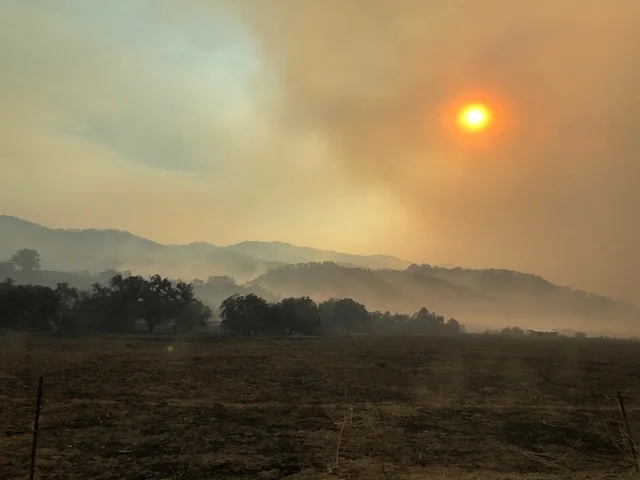
The Thomas Fire burns across Sulphur Mountain toward Oak View, December 4, 2017. Photo Credit: Chris Diel
This sh*t is getting personal.
At 8:45 pm on Monday December 4, I was packing up to leave a meeting in downtown Ojai when I noticed my phone screen lit up with several texts.
From my husband, 7:36 pm:
“Have a fire near SP. Sky looks scary but all good right now. Monitoring the live Fire Dept feed.”
From a friend, 8:18 pm:
“Offering my place to you guys in Oak View if you need it. I have a dog door and big fenced yard”
Husband again, 8:36 pm:
“Second fire near Koeningstein road. Too close for me so I grabbed a few things best I could and we are headed down to you”
And it was on. I had been nervous about wildfires all during Ojai’s hot, crispy summer, then as winter approached I mostly forgot about it—even though it hadn’t rained. I just don’t think of December as fire season. Even as I waited for my husband and dogs to join me on what would become our evacuation odyssey, I wasn’t that anxious. Shock, maybe, but it just didn’t seem real. We stayed at a friend’s house in Oak View that night while the just-built facility in Santa Paula that headquarters the nonprofit she works for was burning to the ground.
Early the next morning, it was time to evacuate Oak View too. The fire had burned its way west across Sulphur Mountain and was currently engulfing houses in the Ventura foothills, headed our way. At that moment, a friend in Oxnard texted to see if we were okay, and offered us her place to stay. We packed up the dogs and headed west on highway 150 toward the 101 so we could get south to Oxnard. A bird flew directly into the grill of my truck. Turning the corner to 101 southbound in Carpinteria, the smoke was a streak of red out to sea as the sun rose ominously behind it. Was this seriously real?
The drive was long, each mile crawling beneath the truck tires. Traffic was not congested, but all of the cars in both directions had slowed down, signaling collective shock, disbelief, and exhibiting an unusual caution. I wanted to drive faster but couldn’t, with a sense that excess speed would send this already-surreal situation spiraling out of control.
***
There was nothing unbelievable about this extremely hot, fast-moving wildfire, really. Rare? Yes, so far. Unbelievable? No. Southern California’s Mediterranean climate is defined by hot, dry summers and cool, wet winters—and an occasional fire. What is so unusual about this fire season is that it extended into winter due to a perfect storm—a wet winter last year that encouraged the growth of vegetation, an extremely dry summer and fall that cooked that vegetation into tinder, and ruthless Santa Ana winds—also at an unusual time of year—that fanned the fire for days on end. This is decidedly not normal. And yes, you guessed it—we are pretty much to blame. We are responsible for suburban sprawl and poor planning, a long history of fire suppression, and climate change.
In fact, climate change is predicted to make the conditions that created the Thomas Fire worse—for example, we are likely see more year-round fire seasons from now on. In 2006, research predicted that Santa Ana wind events would shift to later in the year, from early fall to late fall and early winter. This is exactly what happened during the Thomas Fire. 2017 was the worst fire year on record in California, and the Thomas Fire is the largest in the state’s recorded history.
***

Pyrocumulus clouds forming over the Thomas fire as viewed from Oxnard, December 10, 2017.
We were displaced by evacuation orders for nine days. We watched on the news, as—day after day after day—the Thomas Fire continued to burn. Across Ojai, across the wilderness—so many beautiful places where I explored, wandered, and did the fieldwork for my dissertation research.
We checked the fire perimeter map regularly. When I saw that it had bled across our neighborhood, I thought I was going to puke. A second fire had started at about 7pm on the night that the Thomas Fire started, just two blocks east of our house, upwind of the Santa Anas. This is the fire that tore through our neighborhood that night and eventually joined the Thomas Fire.

Dennison Grade, December 6, 2017.
Two days in, we received word from a neighbor that residents of our small rural community were being allowed past the police barricade, with ID, to assess the damage to their homes. Anxious to find out if we still had a house, we made our way into Ojai, under a heavy snowfall of ash. The air ached in our lungs, even with the poorly placating masks we wore on our faces. We had to wait for hours to get past the police barricade because power lines kept falling down over the road—the poles that usually held them aloft were burned to thin twigs and toppling in the strong winds.
When we finally got through, part of me wanted to turn back around. The mountain I had driven up and down hundreds of times was unrecognizable; nothing was left but ash and blackened sticks where shrubs used to be. Above, in the small valley where we live, it was more intermittent—one house burned to the ground, then two or three left completely unscathed. My heart and gut gripped each other as we rounded the last corner on our street until our house was in view.
Despite the fire burning six houses on our street, our house was there, intact. We put out a smoldering pile of debris on our neighbor’s property with the trickle water pressure we had: the water tanks that serve our neighborhood from our communal well had been drained to battle the fire. With no food or cover left nearby, huge flocks of birds were taking refuge in our yard—yellow-rumped warblers, hermit thrushes—more birds than I had ever seen in our yard at any time of year. In our absence, someone had opened our chicken coop to give our two chickens a fighting chance when the fire came. We found them waiting on our deck, peering into the windows for us. The giant 200-year-old oak tree in our yard even made it through untouched, as it must have for many fires now, at least three in the last 40 years.

Upper Ojai with Sulphur Mountain still smoldering, December 6, 2017
After nine days, the evacuation orders for our area were lifted. For weeks, the smell of smoke has permeated our days. Our area has a bonus hazard—oil seeps that have been burning since the fire came through and have resisted being put out. Some mornings the air reeks of burning hydrocarbons. It has been so bizarre to have to feel safer indoors when normally outside is where I feel most myself.
On December 13, we took our first walk into the wildlands adjacent to our house because I was anxious to see what the fire had done there—I had seen burn scars but never a freshly burned landscape in this kind of habitat. The trail runs along a creek and up a canyon, dotted with oaks and sycamores that provide their sweet, shady canopy cover. This was part of the reason I wanted to live here—I grew up with northern hardwood forests in the Midwest, so having tree branches overhead feels more like home. I was expecting to see a disaster and feel heartbreak as I witnessed my favorite daily hiking spot reduced to ashes.
There were lots of ashes where the underbrush had once been. There were smoldering stumps of old oak trees that had suffered heart rot. There was also an open gallery forest—the removal of the underbrush revealed the creek terraces, open and wide and inviting. The water in the creek ran clear. The strong, healthy oak trees were alive and intact, with just some charring on the outer layers of their bark, and even then only in small patches. Migratory yellow-rumped warblers and white-crowned sparrows flitted between pools in the creek. Scrub jays pounced up in the branches. The fire, at least in this spot, had burned in a patchy mosaic—some areas had been burned hard, and others—including a holly leaf cherry—were green and entirely intact.

Burned underbrush reveals stream terraces and gallery forest. December 13, 2017.
Rather than mourning the loss of this place as I’d always known it, I wanted to wander the freshly open terraces for the rest of the day and explore. In the wild lands, the fire did not feel like a disaster—it felt like a change of clothes.
At the same time, hidden beneath the new landscape is that which cannot be seen because it is now missing. In megafires like this, wildlife lose their lives and habitats more than we can even measure. Wildlife that does manage to escape has nowhere else to go, having lost all of its habitat. Driving the roads in our area since the fire, I’ve noticed a huge reduction in roadkill: the animals—particularly the mammals—just aren’t there to get hit anymore. This part is heartbreaking. Like human populations in parts of the world that have experienced extreme weather and droughts, often those least responsible for climate change are those that suffer the most from its consequences.
I had originally intended to finish this post around Christmastime, with some perspective from its having been in the past. Unfortunately, the aftermath of the fire is still very much present. Just last week, heavy rains in burn areas led to devastating mudslides in Montecito, with the loss of at least 20 human lives. This happens after long, intense fires like the Thomas Fire, and, just like the fire, extremely heavy rainfall on burn areas caused another perfect storm for disaster. Highway 101 is still closed as they try to remove the more than two feet of mud and debris it is buried under. Just like the fire itself, the aftershocks will continue for quite some time.
This is the New Normal. I am neither pessimistic nor optimistic, but hopeful, as Rebecca Solnit writes:
“It is important to say what hope is not: it is not the belief that everything was, is or will be fine. The evidence is all around us of tremendous suffering and destruction. The hope I am interested in is about broad perspectives with specific possibilities, ones that invite or demand that we act. It is also not a sunny everything-is-getting-better narrative, though it may be a counter to the everything-is-getting-worse one. You could call it an account of complexities and uncertainties, with openings.”
A few days ago, more than a month after the fire started, I heard a canyon wren in our yard for the first time. I don’t think this is the same individual that has made a nesting territory that included our yard for the past several years—his voice is higher pitched, and I sense a slightly different dialect. That bird showed up several years ago, offering a sometimes-welcome alarm clock with his overzealously proud song. This new one is probably a younger bird, striking and hopeful. I hope he stays.